Richard Kindersley, The Seven Ages of Man, 1980. Photograph: Andreas Praefcke / Wikimedia Commons.
We talk about ourselves like nouns. I’m a father. An artist. A failure. A success. An introvert. A good person. A difficult person. Smart. Stupid. Broken. Strong. We collect these words over a lifetime and eventually start mistaking them for ourselves. But I’m not sure a person is a noun. I think maybe we’re verbs.
Think about the person you were ten years ago. Not just what you looked like. Think about what frightened you. What you wanted. Who you loved. What you believed about the world. Some of it is still there. A lot of it isn’t. Go back twenty years and things get stranger. You may share a name, a face, some memories and an increasingly questionable amount of the same hair, but that person made decisions you wouldn’t make now. They believed things you no longer believe. They probably worried desperately about problems you can barely remember. And yet we insist that all of these people are one thing. Me. There’s an old philosophical puzzle called the Ship of Theseus.
François Vase, c. 570–565 BCE. Kleitias and Ergotimos. Photograph: ArchaiOptix / Wikimedia Commons.
Imagine a wooden ship. Over the years, boards rot and are replaced. Eventually the mast is replaced. Then the sails. Then the deck. Given enough time, every original piece is gone. Is it still the same ship? It sounds like one of those questions philosophers invent after running out of normal problems. Until you realize the ship is you. Your body replaces itself. Your memories change every time you remember them. Your opinions evolve. Your relationships reshape you. People arrive, people leave, things happen to you that you never expected, and slowly the person who wakes up one morning is not quite the person who went to sleep years before. There probably isn’t a single permanent object hiding underneath all of that. There is a process. You are happening. I find that both unsettling and strangely comforting.
Because nouns can become prisons. If you decide that you are a failure, failure becomes an identity instead of something that happened. If you decide that you’re angry, lazy, selfish, damaged or unlucky, you can start protecting that definition without realizing it. Every new experience gets dragged into court as evidence for a verdict you already reached. People do this with positive labels too. Successful. Strong. The responsible one. The smart one. Those identities can trap us just as easily, because eventually life asks us to become something our old definition doesn’t allow. A verb has more room. You failed. You succeeded. You loved someone. You hurt someone. You learned. You changed. You are still changing.
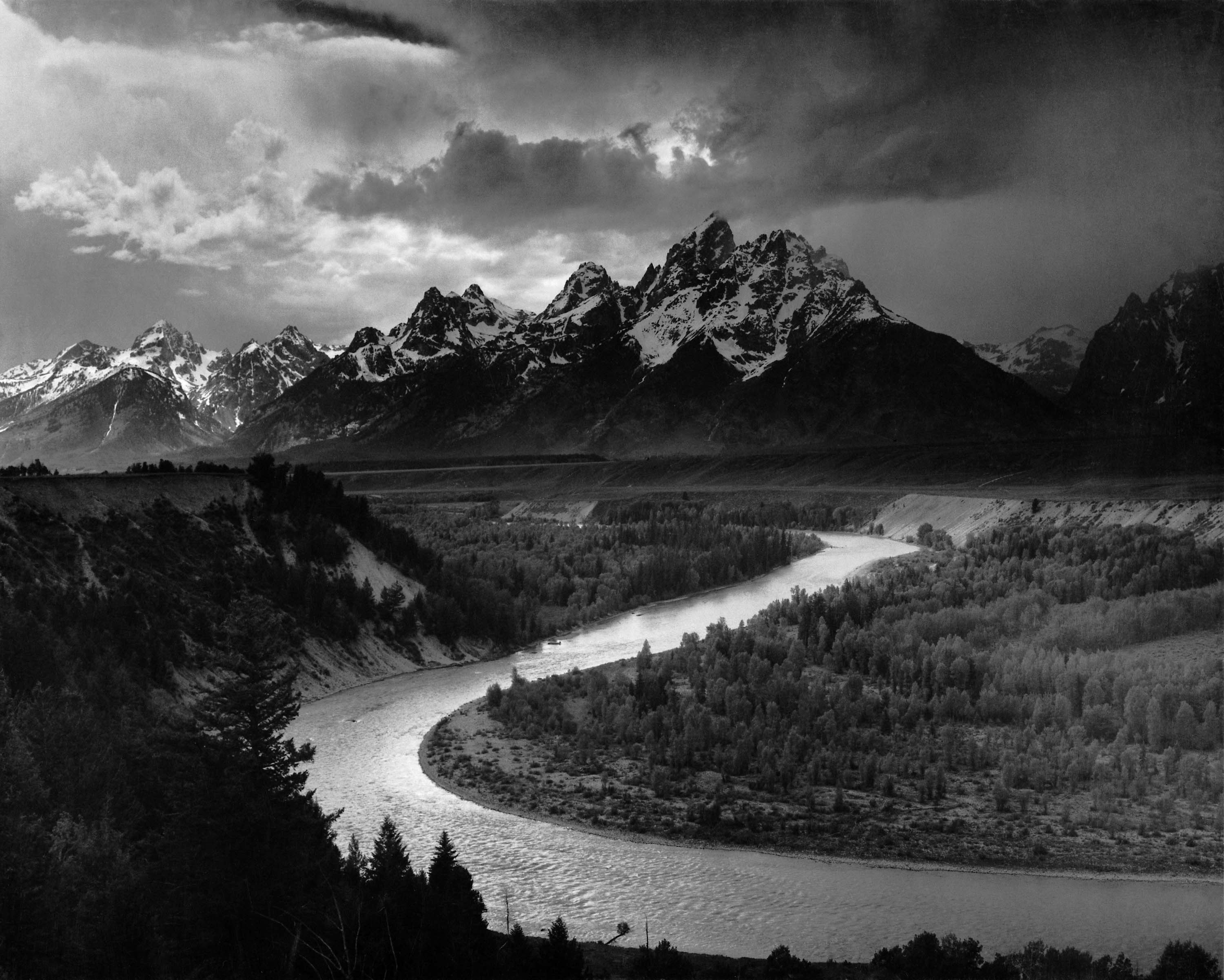
That doesn’t mean there is no continuity. Obviously something connects the child in an old photograph to the person holding it decades later. But maybe the connection isn’t a thing. Maybe it’s a story. A river is still called the Rio Grande even though the water passing Santa Fe today is not the water that was there yesterday. We don’t find that confusing. We understand that the river is not any particular collection of water molecules. The river is the pattern. The movement. The continuation.
Ansel Adams, The Tetons and the Snake River, 1942. National Archives and Records Administration, 79-AAG-1 / Wikimedia Commons. Public domain.
Maybe a human life works something like that. This matters because we spend an enormous amount of time trying to figure out who we are, as though somewhere inside us there is a final answer waiting to be discovered. Maybe there isn’t. Maybe “Who am I?” is the wrong question. A better one might be:
What am I becoming?
That question is a little frightening because it gives us fewer places to hide. We inherit circumstances we didn’t choose, bodies we didn’t design, families we didn’t select, luck we didn’t earn and wounds we didn’t ask for. But within all of that, there is still movement. Tiny choices. Habits. People we forgive. Things we stop tolerating. Things we finally admit. Things we try again. None of us gets to control the whole story. But we do participate in writing the next sentence. So maybe you aren’t a noun after all. Maybe none of us are. Maybe we are unfinished verbs, moving through a world that is doing exactly the same thing.